

The story of the London Transit Commission and the takeover by London City Council is as long and winding as one of its routes.
The Paradox
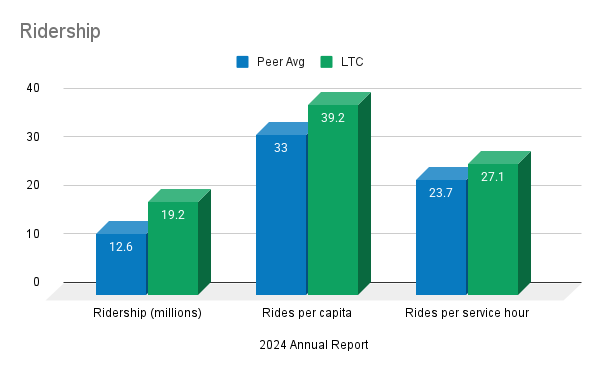
By national performance measures, the London Transit Commission (LTC) is one of Canada’s most efficient transit systems. Yet by municipal funding standards, it sits near the bottom of its peer group. How can one of the country’s strongest-performing transit agencies also be one of its least municipally supported?
That contradiction is the key to understanding nearly every complaint about transit in London today. The real issue is not mismanagement, poor planning, or lack of riders. It is a structural chronic underinvestment from the one partner best positioned to stabilize transit, the municipality itself.
The Facts
In London, our riders pay a higher share of costs than riders in peer cities. We collect roughly twice the provincial gas tax revenue per capita compared to many Ontario systems (page 11). We outperform peer averages on core performance indicators like operating cost per ride and municipal cost per ride. By the numbers, this is not a failing system or mismanaged operation.
Yet despite those facts, London City Council voted 9-6 on March 25, 2025, to dissolve the existing LTC board, citing leadership disputes, ridership concerns, and service complaints. Seven councillors, including the Mayor, now temporarily oversee the service until November 14, 2026, while a governance audit evaluates whether City Hall should directly operate the system. Londoners should familiarize themselves with the data and ask a fundamental question:
Should the very stakeholders who have underfunded the system for years now be granted complete control over it?
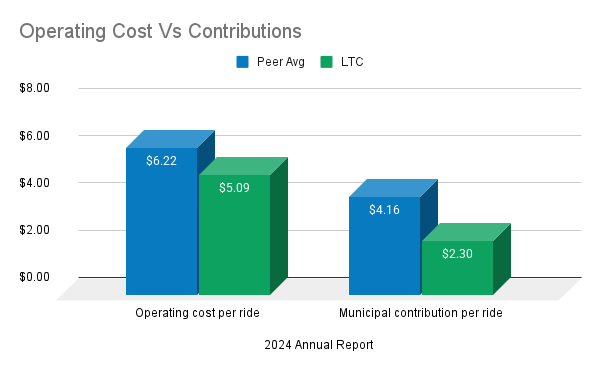
Before changing governance, we should be honest about the numbers and facts. Efficiency without adequate investment leads to fragility. High farebox recovery (cost per ticket) without stable municipal backing (city funding through good budgets devoted to great transit) leads to service pressure. Strong performance metrics do not eliminate the need for sustainable funding.
If we want better frequency, expanded routes, and improved reliability, the conversation must start with the structural funding imbalance.
How Transit Funding Actually Works in Ontario
Transit systems typically rely on three core revenue sources:
- Fares
- Riders pay directly for service. But fares are unstable and regressive; when costs rise, increasing fares risks reducing ridership, which reduces revenue even further in a negatively reinforcing pattern.
- Ontario and Federal Government Funding
- Provincial and federal programs, including gas tax transfers, provide periodic funding. These funds are helpful but inconsistent, often restricted to capital projects rather than daily operations.
- Municipal Contribution
- This is our missing game piece. In well-funded systems, municipal property tax investment stabilizes operations, enables expansion, absorbs shocks (such as fuel spikes or labour shortages), and allows long-term planning. When municipal support is low, systems compensate by stretching every dollar. That may look efficient, but in reality, the system is fragile.
What People Think Is Wrong vs What Actually Is
Ask riders what’s wrong, and you’ll hear the same concerns:
- late buses
- long waits
- crowded trips
- routes that don’t go far enough
The easy conclusion is that something inside the system isn’t working. But that misses the bigger picture. Does the system have the funding it needs to meet the riders’ needs?
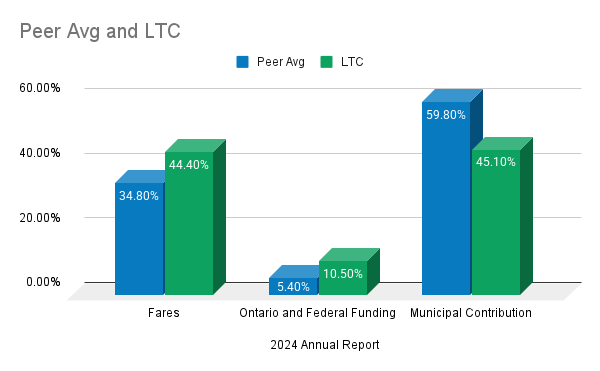
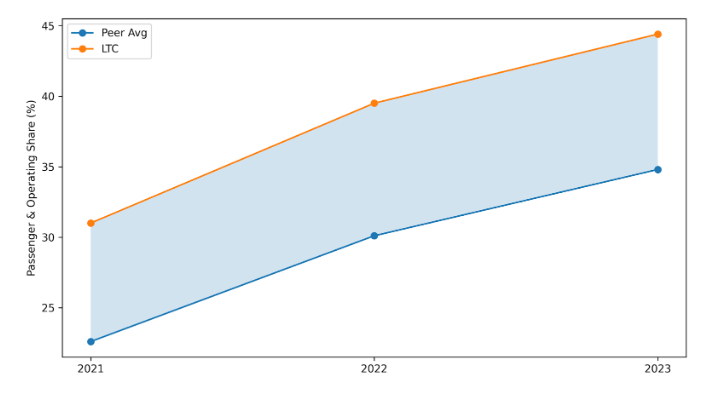
The following charts illustrate how London Transit’s funding structure has diverged from the peer averages over the past three years. The shaded percentage gaps highlight the structural differences that shape service capacity and long-term sustainability.
(Source: LTC 2024 Annual Report)
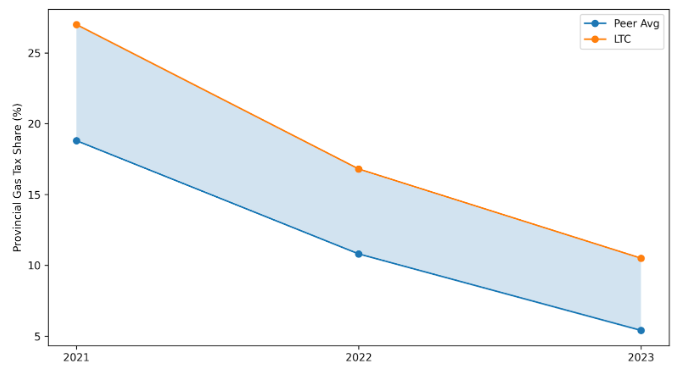
10.5% (LTC) vs 5.4% (Peer Average).
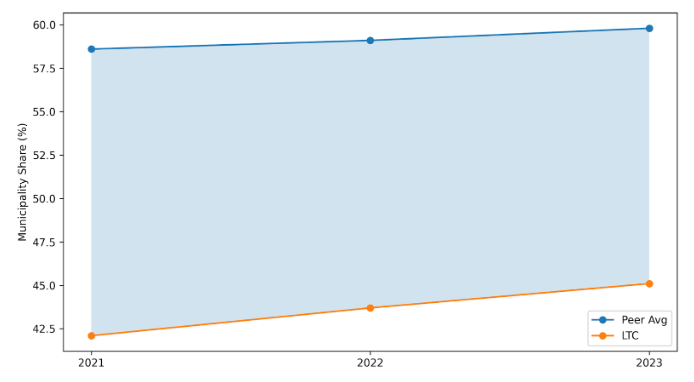
London Transit has been doing more with less for years. The real gap isn’t effort or management, it’s municipal investment. When funding doesn’t keep pace with growth, the impact shows up on the street: longer waits, fuller buses, limited, and unreliable coverage. “Hiking fares to avoid tax increases hurts lower-income individuals more, since they are more likely to ride transit and will spend a larger percentage of their income using the service than those with higher incomes.”
The Reward for Great Performance – Poor Funding
Across all available years, the system outperforms its peers operationally. LTC buses cost less per ride to operate than in comparable cities. It receives less municipal support than comparable cities. It relies more heavily on provincial transfers than comparable cities. That combination is not normal, and this confirms a systemic issue.
These are not signs of a failing agency. They are signs of a high-performing system approaching the limits of underfunding.
The Efficiency Trap
Efficiency sounds like success, but politically it can become a liability. When a system consistently does more with less, decision-makers may assume that the system can continue doing more with less. Funding increases get delayed because the system “seems fine.” But efficiency has limits. After years of stretching resources, systems reach a tipping point where problems surface quickly and simultaneously.
Efficiency without reinvestment is not sustainability; it’s a deferred painful lesson. London’s transit system is showing early indicators of that tipping point:
- Aging fleet pressures
- Skilled mechanic shortages
- Difficulty extending routes to new developments (made worse by ever-expanding sprawl)
- Risk of ridership plateau if service stagnates
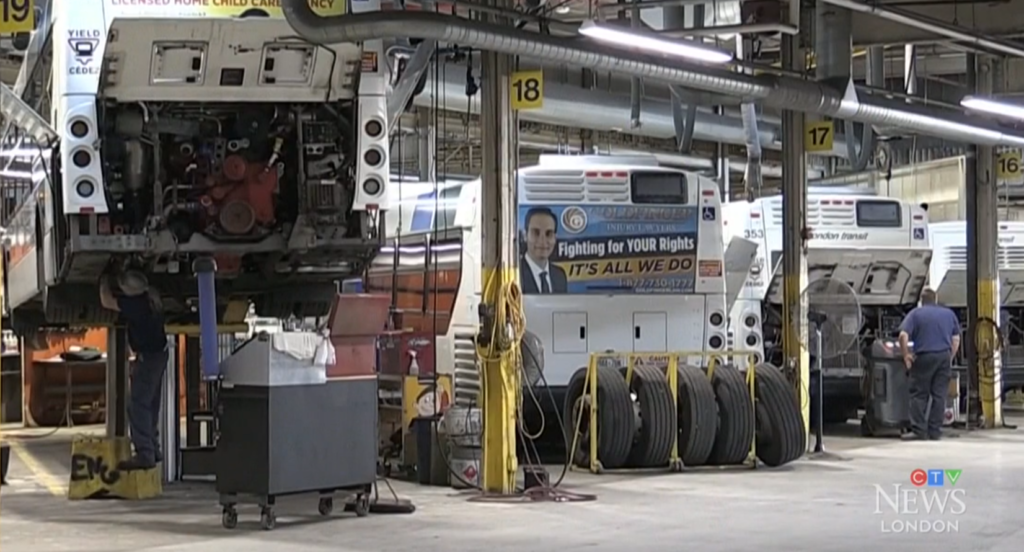
(Photo credit: Daryl Newcombe, CTV News).
These are not signs of a failing agency. They are signs of a high-performing system operating beyond its limits through underfunding. Transit investment isn’t just a transit issue. It’s a citywide economic one.
Underfunded transit contributes to:
- Increased traffic congestion
- Higher household transportation costs
- Barriers to employment access
- Reduced housing affordability
- Limited economic growth potential
When Expectations Detach From Reality

Recent public statements from elected officials illustrate this disconnect. Criticism has focused on why service improvements are not happening faster despite budget increases.
But that framing ignores three realities:
- Catch-up costs
- When a system has been underfunded for years, new funding doesn’t create expansion. It first repairs deferred needs like staffing, maintenance, and fleet renewal.
- Inflationary pressure
- Transit agencies face rising fuel, labour, and parts costs. Funding increases often simply maintain existing service.
- Growth pressure
- Population growth increases demand faster than budgets increase supply.
So what looks like “more money with no improvement” is often actually “more money just to break even.”
Reframing Accountability
(Derek Ruttan/The London Free Press)
If a transit system is inefficient, the solution would be full reform. If it is poorly managed, the solution would be oversight. But when a system is outperforming its peers while receiving less funding, the solution isn’t correction. It’s recognition.
The conversation should shift from: “Why isn’t transit better?” to “Why aren’t we investing proportionally in something that already performs exceptionally well?”
That’s not an operational question. That’s a governance question for our council to hold themselves accountable for the current state.
And if municipal support matched peer levels, the results would not be theoretical. They would be immediate:
- shorter wait times
- more frequent service
- new routes to growing neighbourhoods
- faster repairs
- expanded evening and weekend service
- reduced crowding
- long-term fleet modernization
In other words: visible improvements riders would feel within years, not decades.
For years, this transit system has done something remarkable: it has protected riders from the consequences of underfunding.
- It stretched every dollar
- It secured outside revenue
- It outperformed its peers
Call to Action
This debate over transit funding is happening right now.
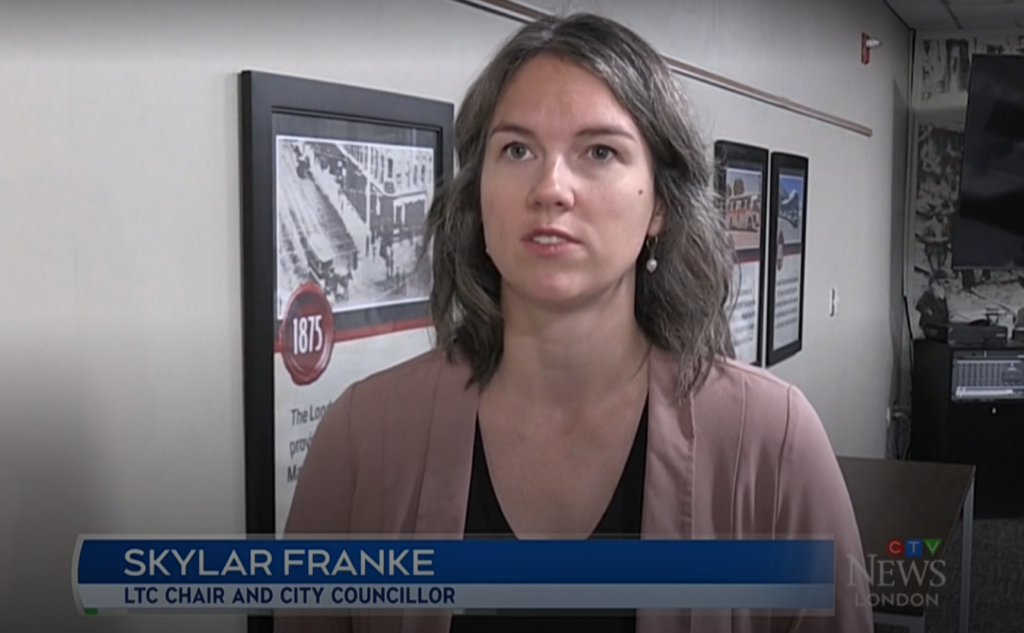
Skylar Franke, LTC Chair and city councillor, has publicly stated that municipal contributions to transit should be viewed as an investment, not an expense.
“There are many subdivisions and industrial areas that need more service, and it makes sense for that to come from assessment growth. As a city, we’re growing, it’s expanding, and the need for transit is expanding into these newer areas.”
… And the same could be said about the Police’s ballooning budget, which the City Council has no issues funding as “an investment.” Growth is happening. Property tax revenue is growing. The question is whether transit will finally grow with it. Watch for this issue on the council agenda. Re-read this article. Then write your councillor and tell them you support the City of London investing in a transit system that has been punching above its weight for too long.
If we want better service, expanded routes, and a system that keeps pace with our city’s growth, municipal leadership must step up, not step back. Efficiency is not a substitute for investment. It’s a temporary shield, and shields wear out.
So, the real question is NOT whether the city can afford to invest more in transit.
Rather, it’s whether the city can afford NOT TO INVEST more in transit.
About the author

Andrew Hunniford is a London, Ontario based community advocate, business leader, and active transportation champion. He previously led a local Bicycle Cafe, recognized as the 2024 Small Business of the Year, and works at the intersection of mobility, entrepreneurship, and civic life. He contributes to community storytelling through The Patch and supports inclusive employment initiatives with Hutton House. A lifelong Londoner, Andrew writes about transit, housing, and municipal finance through the lens of Strong Towns principles, advocating for practical investments that build financially resilient neighborhoods and stronger local communities.
*This article was peer reviewed by Lawrence Durham, Ben Durham, and Charlene Jimmo.
Leave a Reply