

[6-minute read]
The City of London is caught in a Growth Ponzi Scheme… and it’s not alone. Most cities in North America are also caught in the same trap.
Here’s how it works: a city builds new infrastructure, say on the edge of town, to support a new suburb. That development brings in quick revenue through development charges (and other fees) that may cover the costs of installing the infrastructure. It looks like a win. However, it’s a sugar high.
The problem is that the long-term cost of maintaining all that far-flung infrastructure is far greater than the initial cash infusion generated from the development charges (along with new property taxes, new sales taxes, and new utility fees). So when the maintenance bills for that infrastructure come due, say in 25 years, the city is on the hook. If it doesn’t have the money, it approves more new development on the edge of town to get another hit of short-term cash. And the cycle repeats.

.jpg)
It’s called a Growth Ponzi Scheme because it only works as long as the city keeps growing. But eventually, the city’s whole financial system starts to crack. That’s where many cities are today, struggling to maintain what they’ve already built, with no clear way to pay for it.
A recent example in London
On Jan 20, 2026, CBC News reported that a “Funding gap leaves the Horton-Wharncliffe intersection upgrade with no start date.”
Even though the city began studying upgrades to the intersection of Wharncliffe and Horton streets back in 2014, the $90 million project is still stalled 12 years later due to a $39 million funding gap.
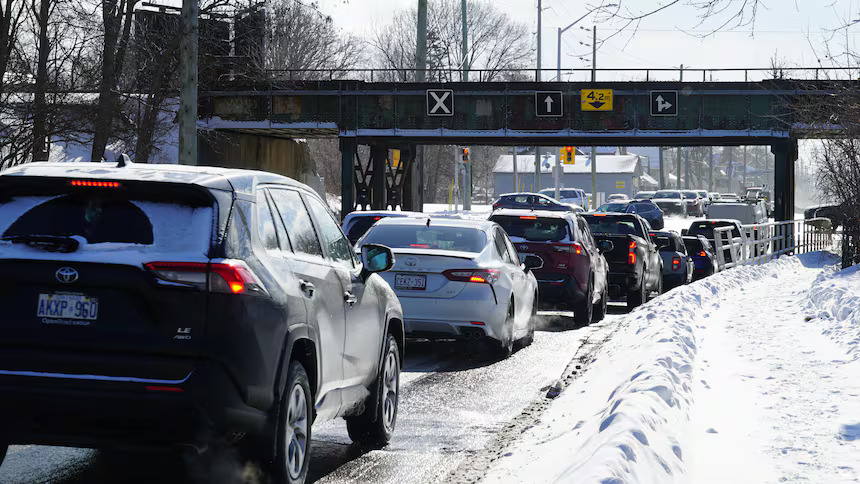
The CBC article notes that “one pressure point has been lower-than-expected revenue from development charges (DCs), which are the fees developers pay to the city to cover growth costs.”
Why is there lower-than-expected revenue from development charges? “A city staff report in October said DC revenues have been dragged down by as much as 50 per cent by a combination of factors, including lower than expected population growth.”
Which brings up the question, how was the city planning to cover that $39 million shortfall in the first place?
Proof of unsustainability without constant growth
In last year’s capital budget, the city had allocated $51 million for this $90 million project. To cover the difference, the city was counting on DCs to fund $21 million, with CN Rail contributing just under $6 million. “The final $12.5 million was slated to come from borrowing, with the taxpayer-supported budget responsible for those borrowing costs.”
So, there you have it. If the city stops growing and developing its land, planned infrastructure projects come to a screeching halt. Notice also in the previous paragraph that the “final $12.5 million was slated to come from borrowing.”
That means that, EVEN WITH development charges, the city would STILL have had to resort to borrowing money and paying interest. This means that the City of London can’t fund infrastructure projects from its own tax base. This makes the City of London more vulnerable to shocks; it is less resilient, and ultimately, the city becomes more fragile.
Fortunately, the City of London put this project on hold. It was wise to wait until it could figure out how it would pay for its expenses from its existing tax revenues, without relying on development charges or going into more debt.
And it’s only going to get worse
In just four years, from 2019 to 2023, city reports clearly show that London’s infrastructure gap is growing.
In 2019, the Corporate Asset Management Plan revealed the following:
- “Based on existing City budget, the infrastructure gap is expected to grow from the current gap of $167.9 million to $568.8 million within the Plan’s 10-year period of analysis.” (source: page 11,/ backup PDF).
- And what role does road infrastructure play?
- “The Cumulative Infrastructure Gap for Transportation assets (Roadways, Structures, and Traffic) would grow to more than $223M over the next decade. Trends presented are primarily driven by the Main Roads renewal, which accounts for roughly 72% of this deficit.” (source: page 165).
By 2023, the Infrastructure Gap increased. According to the latest Corporate Asset Management Plan,
- To maintain the CURRENT Level of Service (on the $28.5 billion worth of infrastructure under the direct ownership and control of the City of London), the 10-year Infrastructure Gap is $946.1 million.
- To achieve the PROPOSED Level of Service, the 10-year Infrastructure Gap rises to $1.3781 billion (see table and graph below).
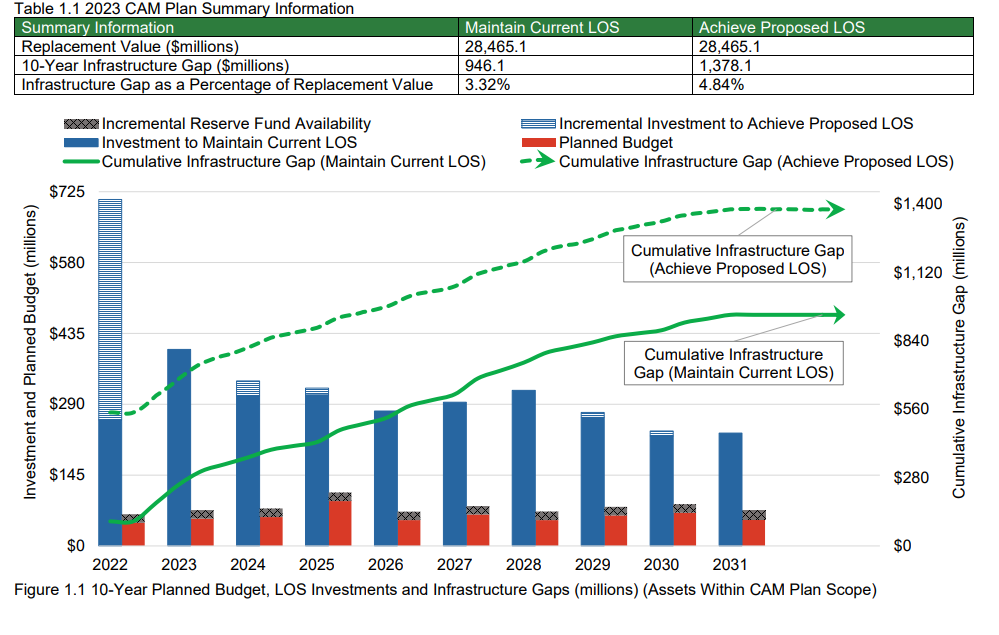
Yikes! Even if you are not a financial wizard, you can see that the trend line is going in the wrong direction.
The North American Growth Ponzi Scheme
By considering these examples from London, you’ve just dipped your toe into a much deeper pond.
If you are curious to learn how this Ponzi Scheme came about, I invite you to read America’s Growth Ponzi Scheme by Strong Towns. It is, by far, its most accessed and cited article and is well worth the read!

(Photo by Abraham Barrera on Unsplash)
But be warned. Once you see how this Growth Ponzi Scheme works, you can’t unsee it. And then you’ll want to know more, especially once you realize that you’re not the only person in the world who has had the same nagging feeling that there is something wrong with the unrestrained growth of cities.
And you’ll be joining thousands of people from all over North America who also realize that the way our cities are growing isn’t working and who are committed to doing something about it.
Where do we go from here?
Mahatma Gandhi once said, “Be the change that you want to see in the world.”
Strong Towns is a global movement that advocates for financially resilient, walkable, mixed-use communities to replace unsustainable urban growth. With over 290 local groups across North America, it shapes local policies and public discussion through grassroots engagement and education.
If you want to be involved locally, we invite you to connect with the local Strong Towns London group.

Lawrence Durham is a member of Strong Towns London, where he regularly engages in local conversations about how to improve the city, such as the intersection at Wharncliffe and Horton. Lawrence is a cheerful, unapologetic optimist known for being relentlessly curious about London and writing about all the amazing things he finds happening in the city he calls home. In addition to running London Bicycle Tours, you may see him riding around the city in all four seasons. Yes, even during our cold Canadian winters!
This article was peer reviewed by Luis Patricio, Sandra Miller, and Ben Durham.